The Definitive Beginner-to-Expert Guide to ChatGPT 5.2 PRO
A Complete, Plain-English Educational Treatise
Let’s start with the honest truth:
You don’t need to “love AI.”
You don’t need to be “techy.”
And you definitely don’t need to be a programmer.
ChatGPT 5.2 PRO matters because it represents a new kind of tool, not a machine that just does tasks, but one that helps humans think better.
Think of it like this: A calculator helps you calculate, a spellchecker helps you spell, but ChatGPT helps you reason, explain, plan, and communicate. That’s new.
This guide is for beginners who feel confused or intimidated, professionals who want real understanding, not buzzwords, and curious people who want to know what this thing actually is
By the end, you won’t just know what ChatGPT 5.2 PRO is, you’ll understand how it works, what it’s good for, what it’s bad at, and how to use it wisely.
Before ChatGPT (A Short History of Human-Machine Intelligence)
Before ChatGPT, computers were basically obedient calculators. You told them exactly what to do: “If X happens, do Y.” “If the user clicks this button, show that screen.”
This is called rule-based software. The problem is that humans don’t think in neat rules. Language is messy, questions are vague, reality is full of “it depends.” So engineers tried building smarter systems; expert systems, decision trees, automation tools, but they all hit a wall.
Then came machine learning. Instead of programming rules, we trained machines on examples. And eventually, this led to Large Language Models. That’s where ChatGPT comes from.
What Is ChatGPT 5.2 PRO? (Plain-English Explanation)
Let’s strip this all the way down.
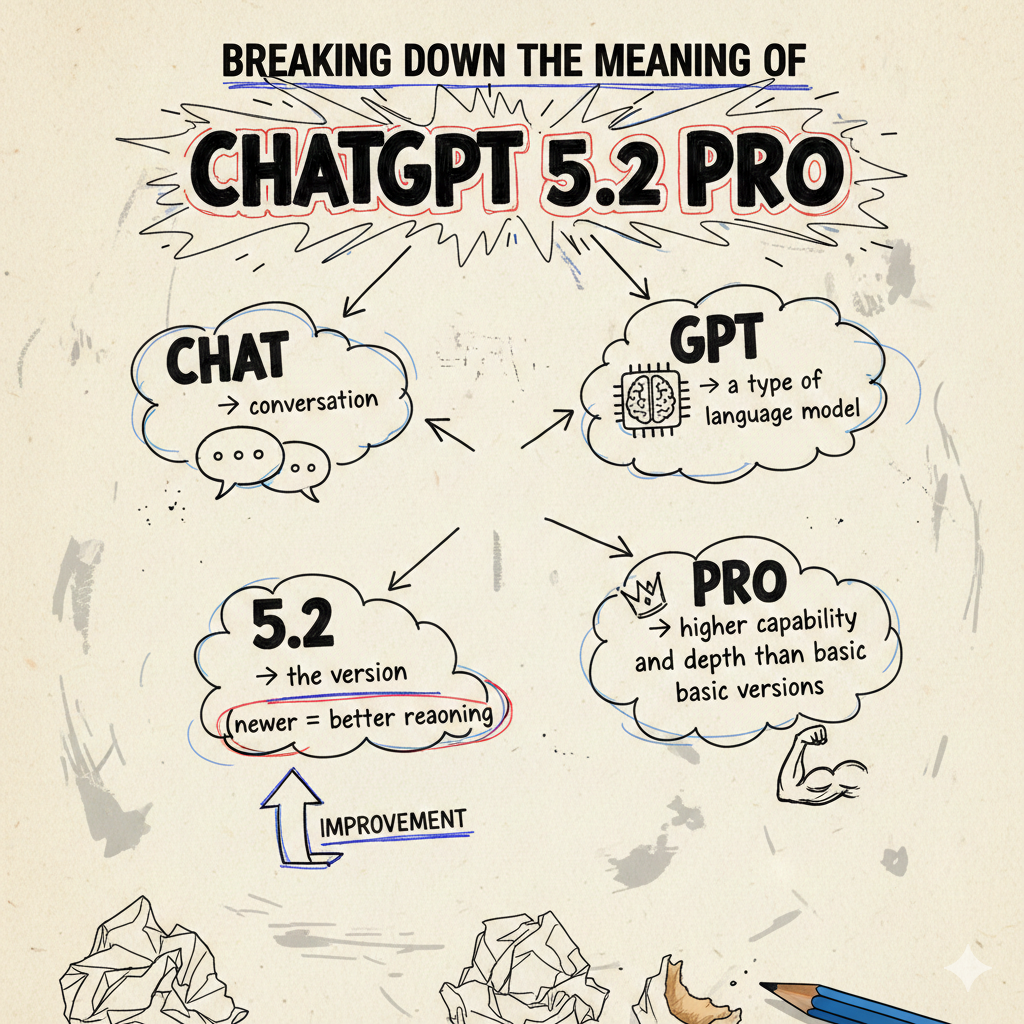
ChatGPT 5.2 PRO is a language-based artificial intelligence system that can understand text and respond intelligently. That’s it.
What it is not: ChatGPT is Not a human, Not conscious, Not a search engine, and it’s definitely Not a mind reader. Think of it like an extremely well-read assistant who has studied millions of books, articles, and examples of human writing, and learned the patterns of how people explain things.
How ChatGPT 5.2 PRO Works (Without the Math)
Here’s the kindergarten version.
ChatGPT does one core thing: It predicts what word should come next. That’s it.
But it does this at an insanely advanced level using tokens. Tokens are tiny pieces of text. So, ChatGPT doesn’t read words as humans do; it reads tokens (small chunks of text). Also, it has what is called Context Window (Short-Term Memory), meaning that it remembers what you’ve said within the conversation so it can stay on topic. That also means that most of the answers you’ll get from ChatGPT are based on Probability, Not Certainty. It doesn’t “know” answers. It predicts the most likely helpful response based on patterns it learned during training. That’s why it sounds confident, but still needs human judgment.
What Makes ChatGPT 5.2 PRO Different From Earlier Versions
Earlier AI models were like smart parrots, good at sounding right, but bad at reasoning deeply, while ChatGPT 5.2 PRO is better at following instructions precisely, keeping long conversations coherent, explaining complex ideas simply, reasoning step by step, and reducing nonsense answers (called hallucinations). In short, it’s less random, and more thoughtful.
Core Capabilities: What ChatGPT 5.2 PRO Can Do
- Language Understanding: It can rewrite text, simplify explanations, change tone (formal, friendly, casual), and translate ideas, not just words
- Reasoning & Problem Solving: It can walk through problems step by step, compare options, explain trade-offs, and help you think, not just answer.
- Teaching & Learning: It’s an excellent tutor when it comes to explaining concepts in multiple ways, adapting to your level, never getting tired of questions
- Creativity: It can brainstorm ideas, help with storytelling, and generate examples and metaphors.
5. Structured Thinking: It helps organize plans, outlines, processes, and workflows.
What ChatGPT 5.2 PRO Cannot Do (This Is Important)
Let’s be clear. ChatGPT cannot verify facts in real time, replace professional judgment, make ethical decisions for you, guarantee correctness, understand emotions the way humans do. It sounds confident, even when wrong, and that’s why you stay in charge.
Understanding Prompts: How Humans Talk to ChatGPT
A prompt is just what you say to ChatGPT.
Bad prompt:
“Explain this.”
Good prompt:
“Explain this concept to a beginner using simple language and examples.”
The clearer you are, the better it performs. Think of prompts like giving directions to a very literal helper.
Advanced Prompting (Without the Fancy Words)
Here’s the secret most people miss: ChatGPT works best when you tell it who to be, what to do, and how you want the answer. For example: “Act like a patient teacher. Explain this concept to a 10-year-old using simple words and examples.”
That’s not magic. That’s good communication.
Real-World Use Cases
Here are few ways you can make use of ChatGPT 5.2 PRO.
- Business: For writing drafts, clarifying ideas, planning strategies, and explaining numbers in plain English.
- Education: For studying, breaking down hard topics, and creating practice questions.
- Law & Policy: For understanding documents, exploring arguments, and clarifying legal concepts (not legal advice).
- Technology: For explaining code, planning systems, understanding technical ideas.
- Creativity: For content ideas, scripts, and outlines.
In all of the use cases, take ChatGPT as a Thinking Partner, Not a Replacement.
This is critical. ChatGPT is best used as a second brain, a thinking mirror, a clarification tool, Not a decision maker, a truth machine, and definitely not a replacement for responsibility. The human stays accountable.
AI reflects its training, bias exists, and mistakes can cause harm. Hence, a responsible use means double-checking important outputs, not outsourcing judgment, and knowing when not to use AI.
Beginners oftens make the mistake of trusting answers blindly, asking vague questions, treating AI like Google, assuming confidence equals correctness, or overusing it without understanding. Avoid these, and you’re ahead of most users.
You can use it in your daily life for thinking out loud, clarifying decisions, drafting ideas, learning faster, reducing mental load, but never as your final authority, not for critical decisions alone, and definitely not for replacing human care.
Final Note: The Future of Human-AI Collaboration
We’re moving from “AI does tasks” to “AI supports thinking”. Those who learn how to think with AI, not just use it, will have a massive advantage.
Most people will use ChatGPT. Very few will understand it, and now you do. Mastery isn’t about knowing tricks. It’s about knowing what it is, what it isn’t, when to trust it, and when to challenge it.
Used wisely, ChatGPT 5.2 PRO isn’t scary. It’s simply a very powerful thinking assistant, and the human mind still sits in the driver’s seat.
Funding Your SaaS Dream: Bootstrapping, VC, and More
The siren song of launching a Software-as-a-Service (SaaS) business is alluring: recurring revenue, scalability, and the potential for explosive growth. But before diving headfirst into development, a crucial question arises: how do you fund your SaaS dream? The answer, like most things in entrepreneurship, isn’t black and white. This guide explores the three main funding paths – bootstrapping, venture capital (VC), and alternative options – helping you choose the one that best aligns with your vision and risk tolerance.
Bootstrapping: Building from the Ground Up
Bootstrapping, the self-made route, involves financing your SaaS through personal savings, loans, and, crucially, revenue generated by your product. It’s an exercise in frugality and adaptability, demanding resourcefulness and a laser focus on profitability.
Pros:
- Ownership and control: You call the shots. No external investors dictating direction or pressuring for unrealistic growth.
- Flexibility: Pivot and iterate based on market feedback without facing investor scrutiny or pressure to stick to a pre-defined plan.
- Alignment with long-term vision: You build the company you truly believe in, without short-term profit pressures from investors.
Cons:
- Limited resources: Growth can be slow due to restricted capital. Hiring talent, scaling marketing, and expanding to new markets might be hindered.
- Pressure and stress: The weight of success rests solely on your shoulders. Self-doubt and financial strain can be significant burdens.
- Limited network: Access to top talent, experienced advisors, and industry connections might be restricted.
Bootstrapping is ideal for:
- Founders with a clear vision, strong technical skills, and a realistic growth plan.
- Niche markets with lower funding requirements.
- SaaS products with clear value propositions and demonstrably quick paths to profitability.

Venture Capital: The Rocket Fuel for Growth
Venture Capital firms pump significant funds into high-growth potential startups, aiming for exponential returns. This path offers quick access to capital, mentorship, and industry connections, but comes with strings attached.
Pros:
- Rapid growth: VC funding fuels aggressive marketing, talent acquisition, and product development, accelerating market penetration.
- Expertise and network: VCs offer valuable connections, industry insights, and strategic guidance from experienced advisors.
- Validation and credibility: Securing VC funding is a public vote of confidence, attracting top talent and potential customers.
Cons:
- Loss of control: VCs often have significant influence on decision-making, product roadmap, and even your role in the company.
- Pressure to perform: The expectation is to deliver hyper-growth, which can lead to unsustainable practices and burnout.
- Investor expectations: Exit strategies like acquisition or IPO might be prioritized over your long-term vision for the company.
VC funding is ideal for:
- SaaS products with disruptive potential and large addressable markets.
- Founders with ambitious growth plans and a track record of execution.
- Teams ready to scale quickly and handle the pressure of high expectations.

Beyond Bootstrapping and VC: Exploring Alternative Options
The funding landscape offers more than just a binary choice. Here are some compelling alternatives:
- Angel Investors: Wealthy individuals invest in early-stage startups, often motivated by mentoring and supporting promising ventures. They offer smaller investments compared to VCs but can provide valuable guidance and industry connections.
- Debt Financing: Loans from banks or alternative lenders can provide crucial capital without sacrificing equity. However, interest rates and repayment terms can impact your cash flow.
- Revenue-Based Financing: Investors provide capital in exchange for a percentage of future revenue, aligning their interests with your success. This option eliminates upfront dilution but can limit your control over cash flow.
- Crowdfunding: Platforms like Kickstarter and Indiegogo allow you to raise capital directly from a large pool of individual investors. This option is well-suited for products with strong community appeal and engaged pre-launch audiences.
Choosing the Right Path: A Matter of Alignment
The best funding approach depends on your specific goals, risk tolerance, and the nature of your SaaS product. Carefully consider these factors:
- Growth ambitions: Do you seek steady, organic growth or explosive market domination?
- Control and freedom: Are you comfortable relinquishing some control in exchange for faster growth?
- Financial runway: How much capital do you need to achieve your initial milestones?
- Team expertise: Do you have the skills and experience to handle rapid growth fueled by VC funding?
Ultimately, the ideal funding path is the one that aligns most closely with your vision, values, and the core DNA of your SaaS dream. Remember, there’s no one-size-fits all.